

Professional Sports Betting v Financial Trading
The worlds of professional sports betting and financial trading look remarkably similar from the outside. Both involve probability, risk management, data analysis, and the pursuit of edge. A sharp bettor studying NFL spreads or Premier League totals appears to use many of the same tools as a trader analyzing stock charts or options volatility. But does success in one arena translate to the other?
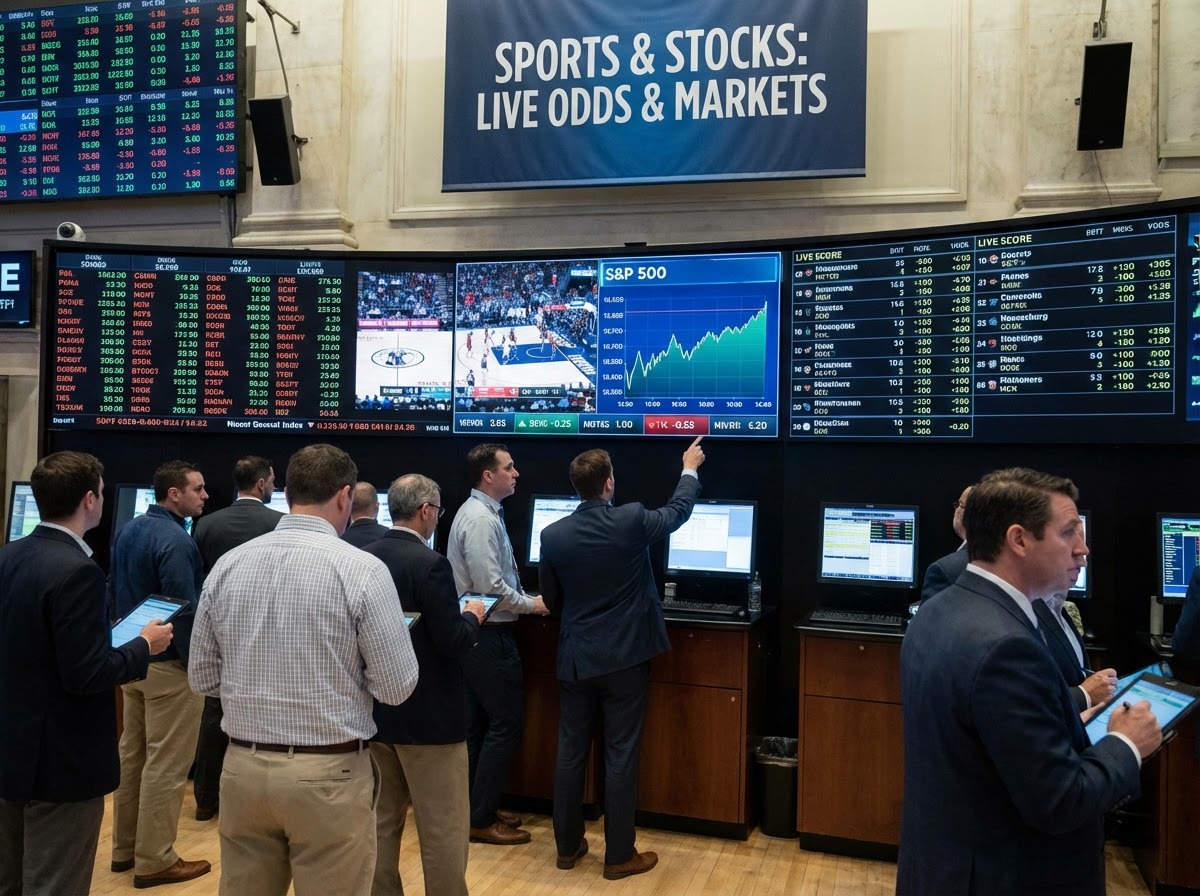
The Overlapping Skill Sets
Probabilistic Thinking
Professional bettors think in probabilities, not predictions. A seasoned bettor does not ask, “Will this team win?” but rather, “Is the implied probability in this line lower than my estimate?”
The same logic drives financial trading. A trader in the stock market or derivatives market evaluates expected value, not certainty. For example, a volatility trader in the Chicago Board Options Exchange environment cares about mispriced implied volatility, not whether a stock will “definitely” rise.
Both professions revolve around identifying mispriced odds.
Risk Management Discipline
The most important skill in both betting and trading is survival.
Professional sports bettors rely on strict bankroll management — often risking only 1–3% of capital per wager. Similarly, disciplined traders use position sizing, stop-losses, and portfolio diversification.
The collapse of firms like Long-Term Capital Management demonstrates what happens when leverage overwhelms risk control. The same fate awaits sports bettors who overbet their bankroll after a losing streak.
Edge matters. But risk control matters more.
Emotional Control
Both environments punish emotional decision-making.
A bettor chasing losses after a bad Sunday slate resembles a trader revenge-trading after a sharp market drawdown. Emotional discipline — avoiding tilt, sticking to process — is essential in both fields.
This psychological resilience may be one of the strongest transferable skills between the two professions.
Where the Differences Become Critical
Despite surface similarities, key structural differences complicate the transition.
Market Structure and Liquidity
Sports betting markets are finite and event-driven. A game settles in hours. A season ends. The outcome is binary or near-binary.
Financial markets, by contrast, are continuous and reflexive. Stocks trade daily on exchanges like the New York Stock Exchange. Prices respond not only to fundamentals, but to expectations about expectations — a far more complex feedback loop.
In sports betting, the bettor does not influence the game. In financial markets, large traders can influence price, liquidity, and volatility.
Information Dynamics
Sports betting edges often come from:
- Injury analysis
- Tactical mismatches
- Weather conditions
- Modeling historical performance
Financial markets incorporate macroeconomics, geopolitics, central bank policy, and global capital flows.
A bettor analyzing a playoff game studies team-level data. A trader might need to understand inflation reports, Federal Reserve policy, currency markets, and global liquidity — all interacting simultaneously.
The information web is much broader in financial trading.
Time Horizons
Sports bets are short-lived. Results resolve quickly.
Trading can be:
- High-frequency (milliseconds)
- Swing trading (days)
- Long-term investing (years)
A bettor used to rapid resolution may struggle with the ambiguity of longer holding periods in financial markets.
Real-World Crossover Examples
There are known cases of crossover success. Financial firms have hired professional gamblers and poker players for quantitative trading roles, particularly in options trading and market-making environments.
For example, firms operating on exchanges such as the Chicago Mercantile Exchange have historically recruited individuals with strong probabilistic and risk-based backgrounds — including gamblers and game theorists.
The logic is simple:
- If you can price uncertainty accurately,
- Manage risk ruthlessly,
- And remain emotionally detached,
you already possess core trading attributes.
The Biggest Risk: Overconfidence
One of the greatest dangers in transitioning from sports betting to trading is assuming the two games are identical.
Sports betting edges can be niche and specialized. Financial markets are deeper, more competitive, and often more efficient — particularly in liquid instruments.
A bettor beating mid-tier sportsbook lines may find global macro trading far more complex and capital-intensive.
Without humility and adaptation, early success in betting could breed costly overconfidence in financial markets.
So — Would They Succeed?
Short answer: Some would. Many would not.
Professional sports bettors already possess:
- Strong probabilistic frameworks
- Risk sizing discipline
- Emotional control under variance
- Experience managing streaks and drawdowns
However, success in financial trading also requires:
- Market structure knowledge
- Macro and microeconomic understanding
- Liquidity awareness
- Regulatory knowledge
- Execution expertise
The mindset overlaps. The domain expertise does not automatically transfer.
Final Verdict
Professional sports bettors are arguably closer to becoming successful traders than the average person. The cognitive architecture — thinking in expected value, understanding variance, protecting capital — is aligned.
But trading is not just “bigger sports betting.” It is a different ecosystem with its own complexities.
The bettors who would succeed are those who:
- Respect the differences
- Relearn the market from first principles
- Treat trading as a new discipline — not a lateral move
In the end, both professions reward the same ultimate trait:
The ability to survive long enough for your edge to compound.